
Goodbye Traditional SEO? How AI Search and ChatGPT Business Hub Are Changing How Customers Find You
For more than twenty years, being visible online meant one thing: getting onto Google’s first page. You picked your keywords, earned some links, collected reviews and hoped to climb above your competitors. That model is not disappearing, but it is no longer the whole story. A growing share of buyers now skip the list of blue links and ask an AI assistant a direct question instead: “Which agency should I hire for SEO in Beirut?” or “What’s the best online shop for running shoes under $100?” The assistant does the searching, the comparing and the shortlisting, and then it recommends.
Search is moving from ranking to being recommended. In November 2026, OpenAI made that shift official by launching ChatGPT Business Hub. In this article we explain what changed, how AI platforms decide which businesses to recommend, how ChatGPT Business Hub compares with Google Business Profile, and the practical steps you can take today so AI assistants recommend your business and website.
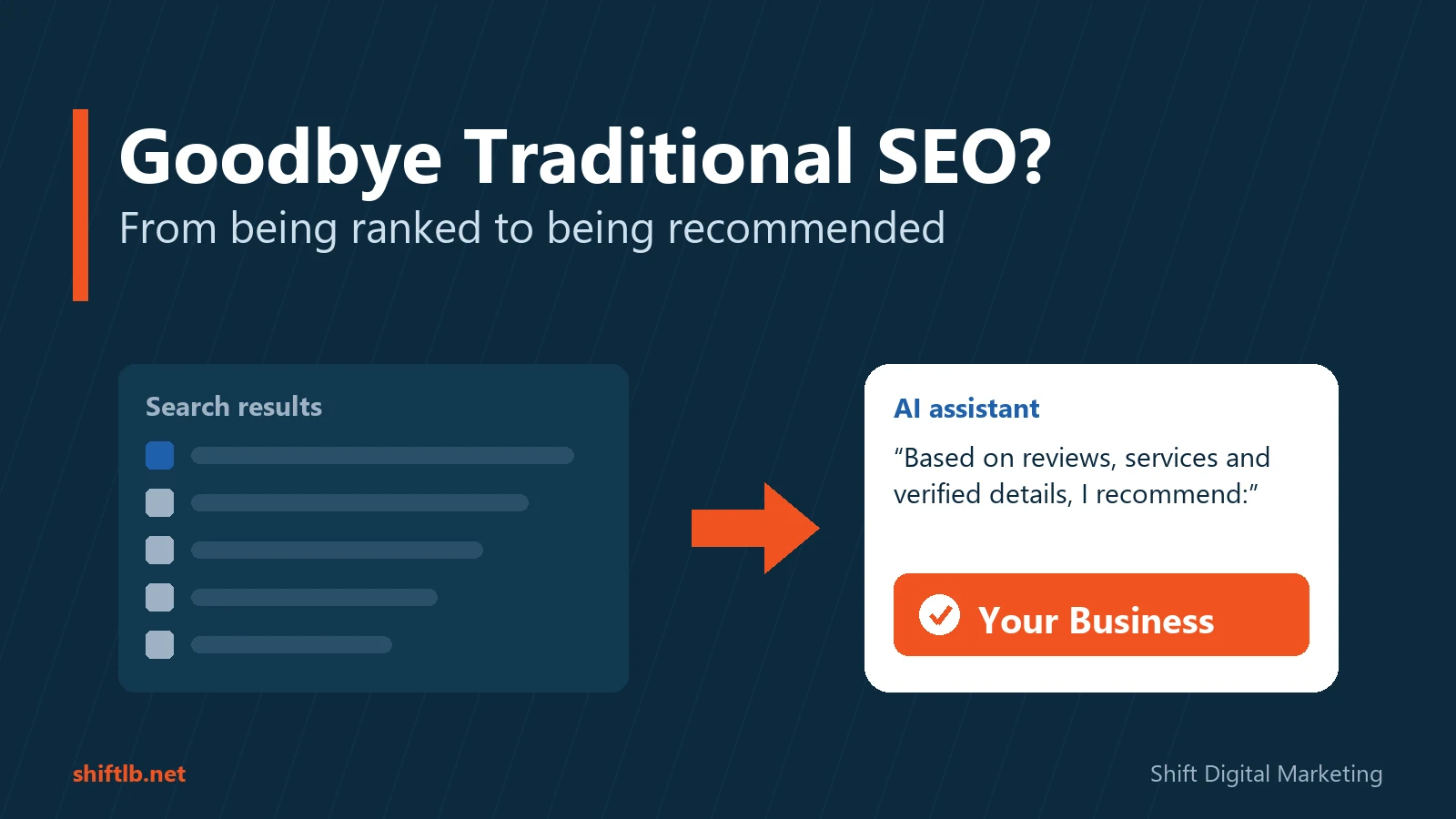
From “Ten Blue Links” to One Recommended Answer
Classic search gives people options. You type a query, Google shows ten results, and you click through several websites before deciding. AI search works differently. ChatGPT, Google’s AI Overviews and AI Mode, Perplexity, Microsoft Copilot, Gemini and Claude read many sources on the user’s behalf and return one summarized answer, often with a short list of recommended businesses or products.
The scale of this change is no longer small. OpenAI reported 900 million weekly active ChatGPT users in early 2026, and Google’s AI Overviews reach more than two billion people every month. At the same time, studies consistently find that around 60% of Google searches end without a click to any website, because the answer is already on the results page. For businesses this means a simple but uncomfortable truth: if the AI doesn’t mention you, many customers will never even see your website.
What Is ChatGPT Business Hub?
On 10 November 2026, OpenAI launched Businesses in ChatGPT in beta, made up of two parts: Business Hub and Business Agents. Think of Business Hub as ChatGPT’s answer to Google Business Profile: a dashboard where companies can take control of how they appear inside ChatGPT’s answers. With Business Hub, businesses can:
- Claim and verify a business profile inside ChatGPT and edit core details such as description, contact information and website.
- Publish a product catalog with prices and stock availability, by uploading a product feed (CSV) or, for Shopify stores, by having eligible products appear automatically.
- See insights on how often ChatGPT mentions the business, how many people view the profile and how many click through to the website.
- Build branded AI agents that talk to customers on the business’s behalf. This is rolling out gradually, starting with eligible US ecommerce and online service businesses.
Profiles are free during the beta and are separate from the paid ChatGPT Business plan for teams. OpenAI also notes that the insight numbers are aggregated, so the mention count is best treated as a minimum estimate rather than an exact figure. You can read the official setup guide in OpenAI’s help center.
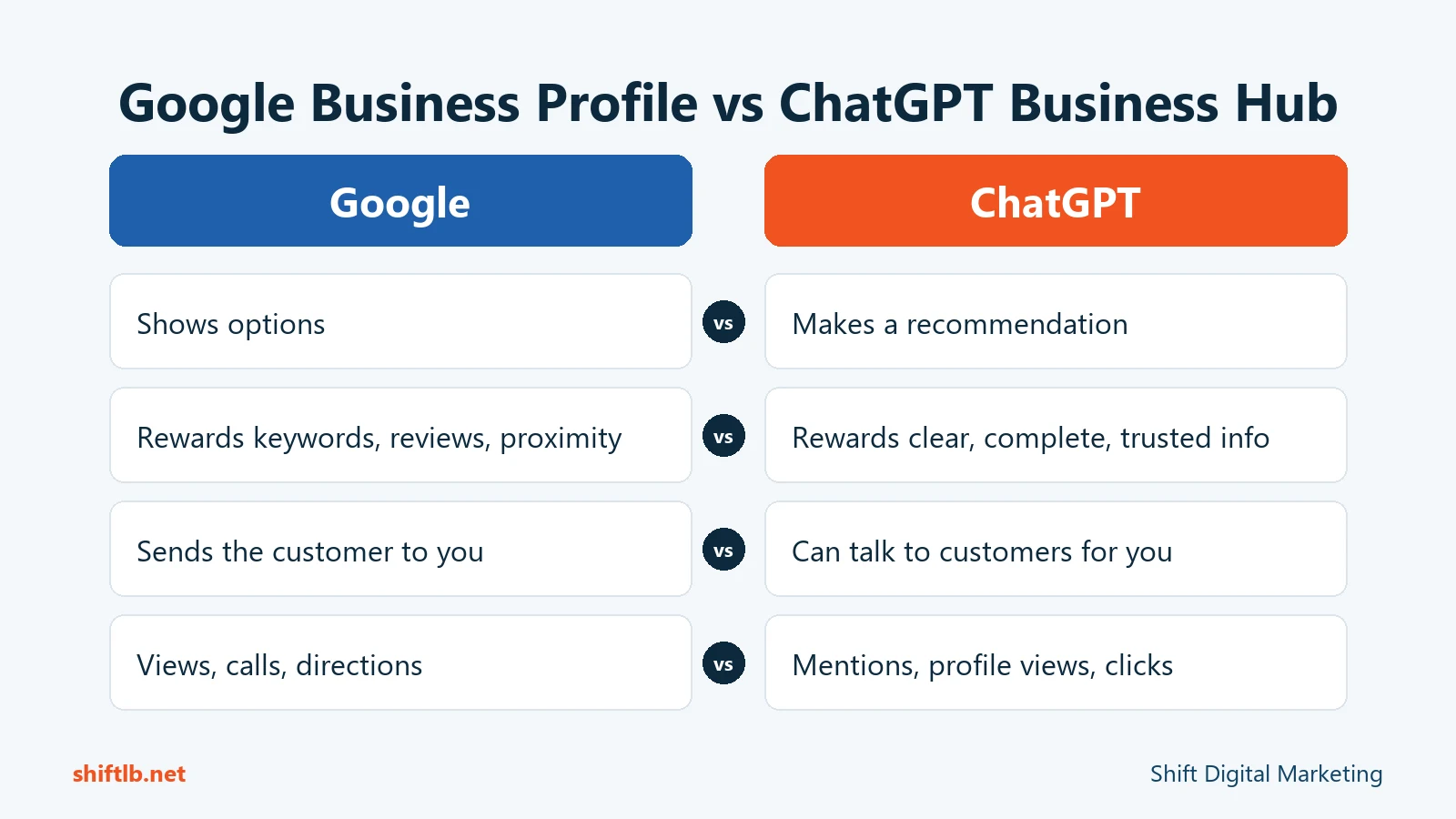
ChatGPT Business Hub vs. Google Business Profile
Both tools let you manage your business information, but they serve very different search experiences. The biggest difference is what happens after the customer asks:
| Google Business Profile | ChatGPT Business Hub | |
|---|---|---|
| What the user gets | A list of options and a map | A direct recommendation in a conversation |
| What it rewards | Keywords, reviews and proximity | Clear, complete, consistent and trusted information |
| Product data | Limited products and posts | Full catalog with prices and stock status |
| Customer contact | Sends the customer to you | Can talk to the customer on your behalf (Business Agents) |
| Insights | Views, calls, direction requests | Mentions in answers, profile views, website clicks |
How AI Platforms Decide Which Businesses to Recommend
AI assistants don’t recommend the business with the most keywords on its homepage. They recommend the businesses they can understand and verify. Research from universities and agencies alike points to the same core signals:
- Clarity: Your website states plainly who you are, what you do, where you operate, who you serve and what it costs. Vague marketing slogans are hard for AI to quote; specific facts are easy.
- Consistency: Your name, services, address and contact details match across your website, Google Business Profile, ChatGPT profile, social media and directories. Conflicting information lowers confidence.
- Independent evidence: Reviews, client case studies, press mentions, awards, partnerships and listings on trusted third-party sites. AI models give more weight to what others say about you than to what you say about yourself.
- Structure: Schema markup (Organization, LocalBusiness, Service, Product, FAQ), clean headings and well-organized pages help AI systems extract the right facts.
- Answer-ready content: Pages that directly answer the questions customers ask, in short self-contained passages that an AI can cite word for word.
- Technical access: AI crawlers such as OAI-SearchBot, Googlebot, Bingbot and PerplexityBot must be able to reach and render your pages quickly.
Traditional SEO vs. AI Search Visibility
| Traditional SEO | AI Search Visibility (GEO / AEO) | |
|---|---|---|
| Goal | Rank on page one | Be mentioned and recommended in the answer |
| Unit of success | Position and clicks | Mentions, citations and referred visits |
| Main levers | Keywords, backlinks, technical health | Facts, entities, trust signals, structured data, answer-ready passages |
| Where it happens | Google and Bing results pages | ChatGPT, AI Overviews, AI Mode, Perplexity, Copilot, Gemini, Claude |
| How you measure it | Search Console, rank trackers | Business Hub insights, AI mention tracking, referral traffic from AI tools |
So, Is Traditional SEO Dead?
No, but on its own it is no longer enough. AI assistants still rely heavily on search indexes to find information. ChatGPT’s search uses web results, and Google’s AI Overviews are built on top of Google Search. A fast, crawlable, well-structured website with strong content remains the foundation. What has changed is the finish line: ranking is now the entry ticket, and being recommended is the win. Businesses that combine solid SEO with AI search optimization will capture both the traditional clicks and the new AI recommendations. Those that stop at keywords will slowly disappear from the conversations where buying decisions are made.
8 Steps to Get Your Business Recommended by AI
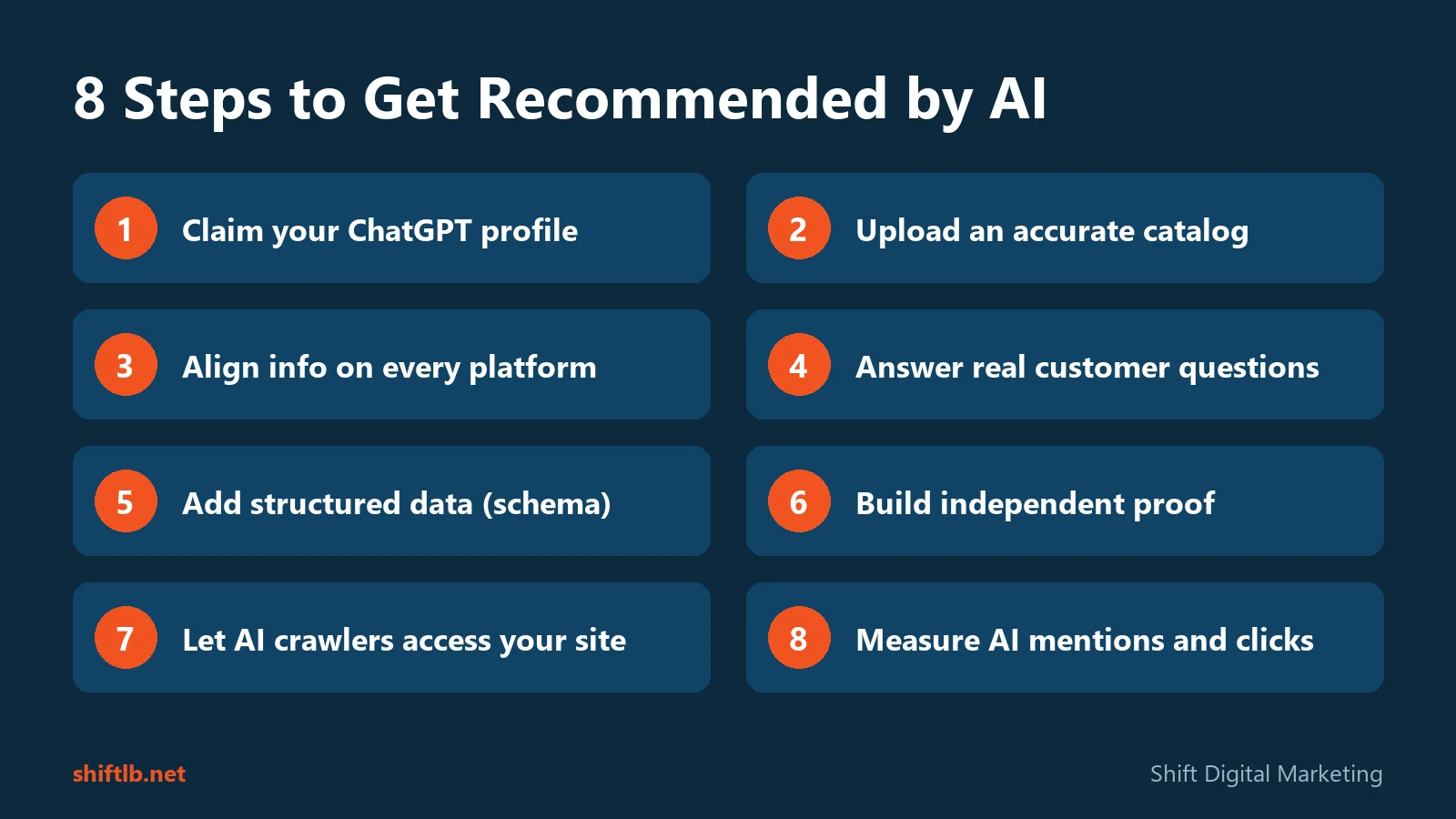
- Claim your ChatGPT business profile in Business Hub and complete every field, the same way you would with Google Business Profile.
- Upload a clean product or service catalog with accurate prices and availability, and keep it updated.
- Align your information everywhere: website, Google Business Profile, ChatGPT, Bing Places, social profiles and directories should all say the same thing.
- Rewrite key pages to answer real questions: what you offer, for whom, where, at what price and why you are different, in short, quotable paragraphs.
- Add structured data such as Organization, LocalBusiness, Service, Product and FAQ schema so machines can read your facts without guessing.
- Build independent proof: collect reviews, publish case studies, earn mentions in trusted media and industry directories.
- Make sure AI crawlers can access your site: check robots.txt, speed and rendering so OAI-SearchBot, Googlebot and Bingbot can read every important page.
- Measure AI visibility, not just rankings: track Business Hub insights, AI mentions of your brand and referral traffic from chatgpt.com, Perplexity and Copilot in your analytics.
How Shift Digital Marketing Helps You Get Recommended
At Shift Digital Marketing, we help businesses become visible and recommended across AI search, not just ranked on Google. Our AI visibility service combines classic SEO with generative and answer engine optimization (GEO and AEO):
- AI visibility audit: we test how ChatGPT, Google AI Overviews, Perplexity and Copilot describe your business today and where competitors are recommended instead of you.
- Profile setup and alignment: ChatGPT Business Hub, Google Business Profile and Bing Places, all consistent and complete.
- Answer-ready content and schema: we restructure your key pages and add the structured data AI systems rely on.
- Website performance: fast, clean, crawlable websites, as our own move to a lighter WordPress build shows.
- Ongoing tracking: monthly reporting on AI mentions, citations and AI-referred traffic alongside your Google rankings.
Whether you serve customers locally with local SEO or sell worldwide with ecommerce SEO, the question is the same: when a customer asks AI, does it recommend you?
Frequently Asked Questions
What is ChatGPT Business Hub?
ChatGPT Business Hub is a free beta dashboard launched by OpenAI in November 2026. It lets businesses claim and verify their profile in ChatGPT, publish product catalogs with prices and stock, and see how often ChatGPT mentions them and sends visitors to their website.
Does ChatGPT Business Hub replace Google Business Profile?
No. Google Business Profile still controls how you appear in Google Search and Maps. ChatGPT Business Hub controls how you appear inside ChatGPT. Most businesses should manage both and keep the information identical.
Is SEO still worth investing in?
Yes. AI assistants still discover and verify businesses through search indexes and websites. Strong SEO is the foundation; AI search optimization builds on it so you are recommended, not just listed.
How do I know if AI recommends my business?
Ask ChatGPT, Perplexity and Google AI Mode the questions your customers ask, check the mention data in ChatGPT Business Hub, and look for referral traffic from AI tools in your analytics. Shift can run a full AI visibility audit for you.
Want to know where you stand? Let’s find out together whether AI assistants recommend your business today, and what it takes to get you there.
Sources: OpenAI Help Center, AIN, Inc., University of Toronto GEO study (arXiv).